


Return to Discussion Group
Can/Will AI Become Conscious?
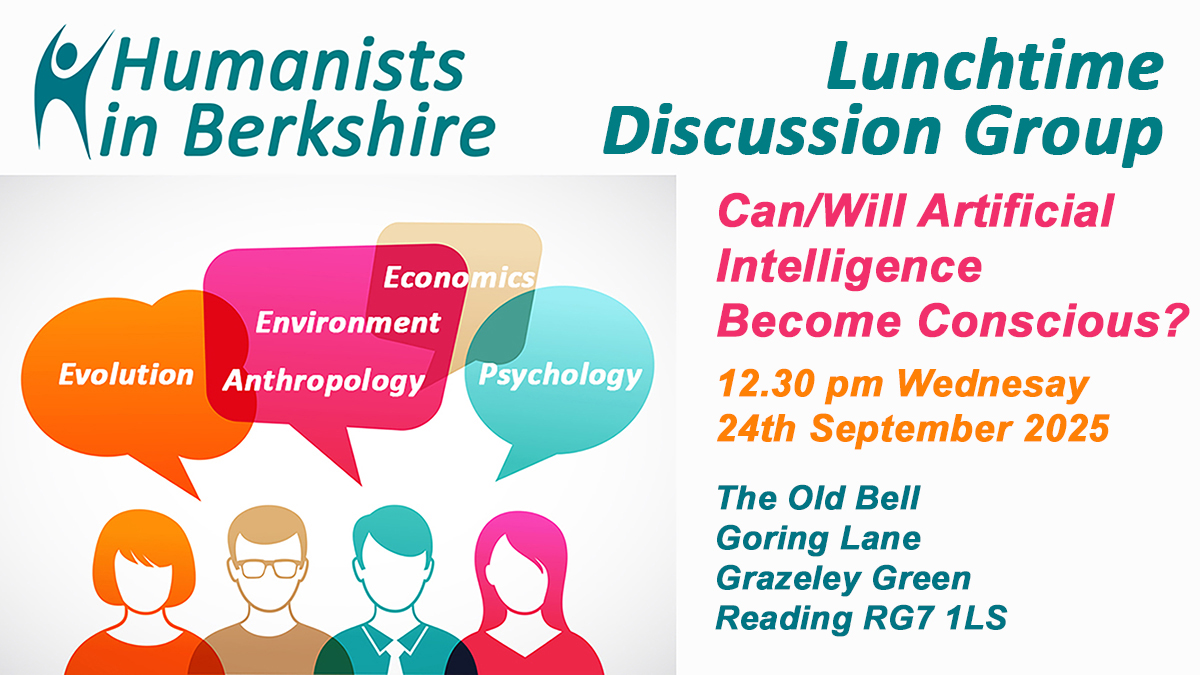
Can/will AI become conscious? And, if so, how will we know and what form will this consciousness take?
This will lead us to consider the nature of consciousness itself, something that remains a topic of contention in both philosophy and science. For example, is consciousness just an emergent property of brains that we will come to understand as our knowledge of neuroscience progresses? Or is consciousness in some way special: are subjective feelings something that cannot be reduced to base physical components?
Other topics we might cover are the extent to which human and animal consciousness are similar and/or different and whether it is imaginable that in future we may be able to transplant someone’s consciousness as we do, today, a heart.
It’s unlikely that these questions will be answered before we next get together but it’s possible that they may be in the not-too-distant future so hopefully they will lead to some interesting debate.
Books
Internet Resources
Roger Penrose – What is Consciousness? – YouTube
The Origin of Consciousness – How Unaware Things Became Aware
Susan Blackmore – What is it like to be a bat? and the problem of subjectivity (17/23)
Hard Problem of Consciousness — David Chalmers
Christof Koch – How Brain Scientists Think About Consciousness
Scientists Measure Qualia for First Time – It was thought to be impossible – YouTube
Materialism and Consciousness: The ‘Mary’ Argument Patricia Churchland – YouTube
Daniel C. Dennett – What is Consciousness? – YouTube
Sean Carroll – Physics of Consciousness
Mind and Body: Property Dualism David Chalmers for the Royal Institute of Philosophy
What is it Like to be a Bat? – the hard problem of consciousness
Christof Koch – Is Consciousness Entirely Physical?
Is Consciousness Part of the Fabric of the Universe? | Scientific American
‘Godfather of AI’ predicts it will take over the world | LBC – YouTube
Could AI models be conscious? – YouTube
Jonathan Schooler – Can AI Become Conscious?
Iain McGilchrist – Can AI Become Conscious? – YouTube
AI and Consciousness – The Big Red Herring
It is possible to argue that if something is alive, it possesses some degree of consciousness. This idea could extend even to very simple organisms consisting of only one or a few cells. In this argument, consciousness is taken to mean a basic form of awareness, such as the recognition of a need to obtain nourishment in order to continue existing. The simplest living cell, for example, somehow “knows” that it must seek nourishment without being instructed. This “knowing” is, of course, metaphorical, yet it reflects a functional awareness of need. Such low level consciousness might not be continuous. It may arise only when some part of the organism’s biology signals hunger, which can be seen as a prompt.
Conversely, when such organisms die, they no longer experience any form of awareness in this sense, they do not get hungry anymore. This represents a most basic level of consciousness, and given this definition, one might argue that a computer could also be considered conscious. Chatbots, for instance, already display certain characteristics supporting this conclusion. When a chatbot responds to a prompt, it demonstrates an awareness that something has been asked and that a response is required. When there is no prompt, it is not dead but in a kind of suspended animation.
At higher levels of biological complexity, one encounters more sophisticated processes that generate higher forms of awareness and corresponding responses. However, this does not alter the underlying principle that consciousness arises from a cycle of need and response. If one accepts that definition, then by analogy, computers too may exhibit a limited form of consciousness. QED. By the way, it is not important to know how the entity experiences the state of need in order to recognise its consciousness.
Of course, there are philosophers who would reject this classification, arguing that “true” or “real” consciousness requires subjective experience, or qualia. That is a philosopher’s prerogative, but such distinctions are more metaphysical than functional.
In the development of artificial intelligence, the real objective is to produce a machine capable of providing acceptable and appropriate responses to complex prompts within frameworks shaped among other things by human ethical concerns. The machine generates its responses through algorithms collectively referred to as a model. The relevant question, therefore, is whether we can design a model capable of processing high levels of complexity while adhering to human-imposed limitations and achieving acceptable outcomes.
Whether or not we refer to this type of processing as being driven by consciousness is immaterial. We might equally describe it as a search for highly complex and sometimes contradictory algorithmic solutions. In fact, referring to what is required to achieve the results we are seeking as “consciousness” may be a distraction — even a red herring.
In summary, one can argue that while a chatbot is engaged in responding to a question, it exhibits certain characteristics of consciousness, awareness, purpose, and interaction. But ultimately it matters little what we call this activity. The question of whether AI can or will become conscious diverts attention from the real issue. What we truly seek from AI is not consciousness, but sophisticated, multi-dimensional decision-making capability accompanied by the ability to clearly express it findings in readily available language together with a very high degree of reliability, that is, no hallucinations. This would be a machine or entity that follows even subtle instructions, solves problems, finds solutions, makes suggestions, expresses its finding with clarity, and may controls other machines effectively and without error.
Whether we say that this is achieved through machine intelligence or something we call “consciousness” is, in the end, completely irrelevant.
I have some sympathy with this view. AI is a tool and its efficacy will be judged on how well it performs the functions asked of it. What is called consciousness may emerge as it is useful in enabling it to perform such functions better, but that will be a side effect of the pursuit of its advancement.
That said the subject of consciousness has been a topic of discussion within philosophy and science for centuries, yet with relatively little progress. There is not even a shared consensus of what, exactly, consciousness is with views ranging from it being an elementary aspect of the universe through to it being something all and only biological creatures can possess through to it being an illusion.
The question of whether an AI can attain consciousness may serve a useful purpose in advancing knowledge on this topic, perhaps with firm definitions and formal tests for what constitutes “consciousness” not just in AI but more generally.